




Update as of Sept. 29, 2025
During the meeting on Monday, Sept. 28, 2026, Roswell City Council approved a millage rate of 5.232 mills for tax year 2026. The rate maintains the 2025 Maintenance & Operations (M&O) millage rate of 4.049, while increasing the Debt Service component (repayment of 2022 voter-approved bonds) to 1.183 mills. Read the full story.
Watch the September 28, 2026, Millage Rate Public Hearing
Update as of Sept. 25, 2026
This page now includes many Frequently Asked Questions (FAQs) that the City of Roswell has received about the millage rate and related issues. Please scroll down to see the FAQ section.
The Second Reading and Adoption of the Millage Rate will be presented at the Mayor and City Council Meeting on Monday, September 28, 2026, at 7:00 p.m., at Roswell City Hall, 38 Hill Street.
Update as of Sept. 22, 2026
Roswell’s Mayor and City Council held a state-mandated public hearing on the Tax Year 2026 millage rate on Monday, September 21, 2026, at City Hall. The single-item agenda began with a presentation from Finance Director Adam Novotney. The Mayor and Council then questioned staff about specific initiatives and expenditures. Finally, residents were able to share their thoughts on the proposed millage rate.
The tentative millage rate proposed by Mayor Robichaux was advertised on September 3, 2026, at a maximum of 7.732 mills. At their meeting on Monday, September 14, City Council voted 4-2 to move the item forward with a tentative revised millage rate of 5.9 mills.
The final rate will be determined and adopted during the City Council meeting on Monday, September 28 at 7:00 p.m. at Roswell City Hall, 38 Hill Street. Before Council votes, residents will have the chance to speak during the public comment period.
Watch the September 21, 2026, Millage Rate Public Hearing
View the Presentation
Update as of Sept. 15, 2026
During the Mayor and City Council Meeting on Monday, September 14, 2026, City Council heard the first reading of the proposed millage rate. The public had the opportunity to comment on the proposal, which had been tentatively advertised on September 3, 2026, at a maximum of 7.732 mills. Council voted 4-2 to move the item forward with a tentative revised millage rate of 5.9 mills. This process will continue with a public hearing on Monday, September 21 before a rate is officially adopted at the City Council meeting on Monday, September 28.
Watch the September 14, 2026, Mayor and City Council Meeting
View the Presentation
Original Story Posted: September 2, 2026
The City of Roswell is proposing to increase its property tax rate, also called a millage rate, for Tax Year 2026 to 7.732 mills. The Tax Year 2025 millage rate was 4.949 mills. Roswell’s property tax rate has remained roughly flat over the last 10 years. If approved during the City Council meeting on September 28, 2026, the increase would help fund long-overdue road and infrastructure improvements, the upkeep of aging City facilities and equipment, and continued investment in public safety.
“We didn’t come to the decision to raise taxes lightly. This comes after a thorough review of our City’s near- and long-term needs,” said Roswell Mayor Mary Robichaux. “We owe it to our brave men and women in uniform to give them the tools they need to keep our City safe. We owe it to the people who drive throughout Roswell to ensure our roads aren’t riddled with potholes. And we owe it to the residents who play in our parks to have grass cut and restrooms clean. This proposed millage rate would allow us to honor those commitments.”
Mayor Robichaux shared additional details about the need for investment in critical City needs in a recent video.
Critical City Needs Driving the Proposed Millage Rate Increase
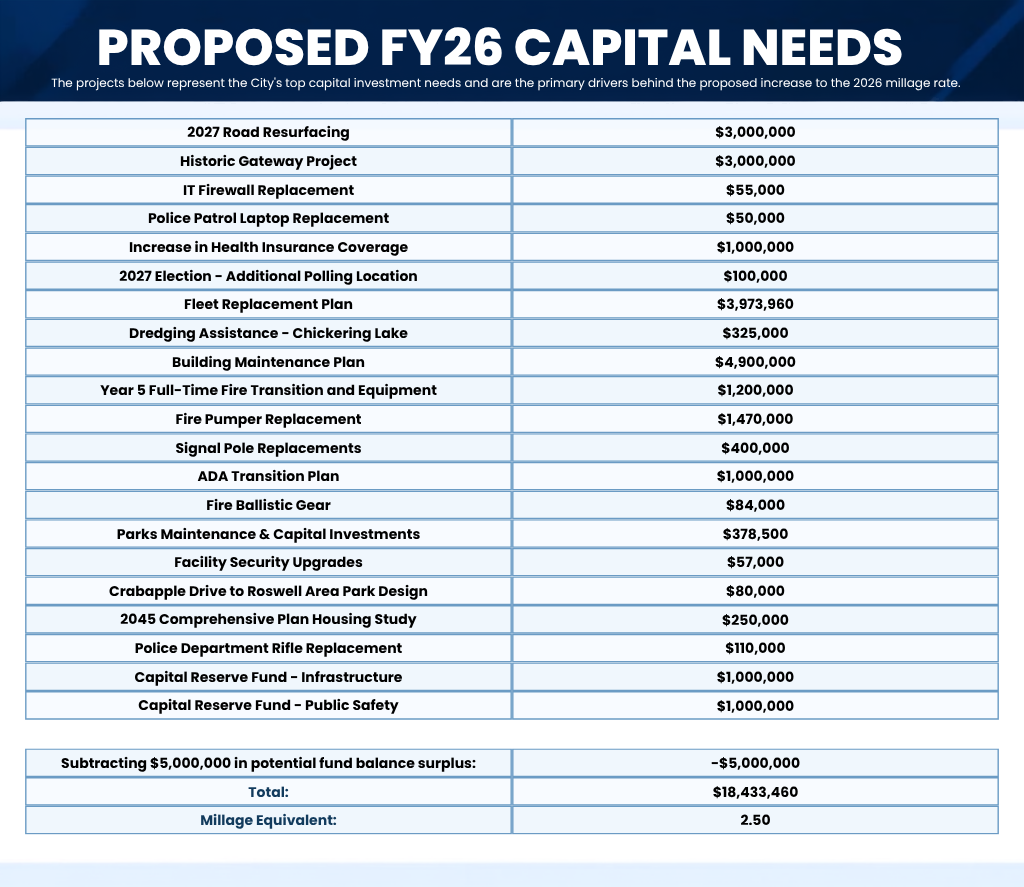
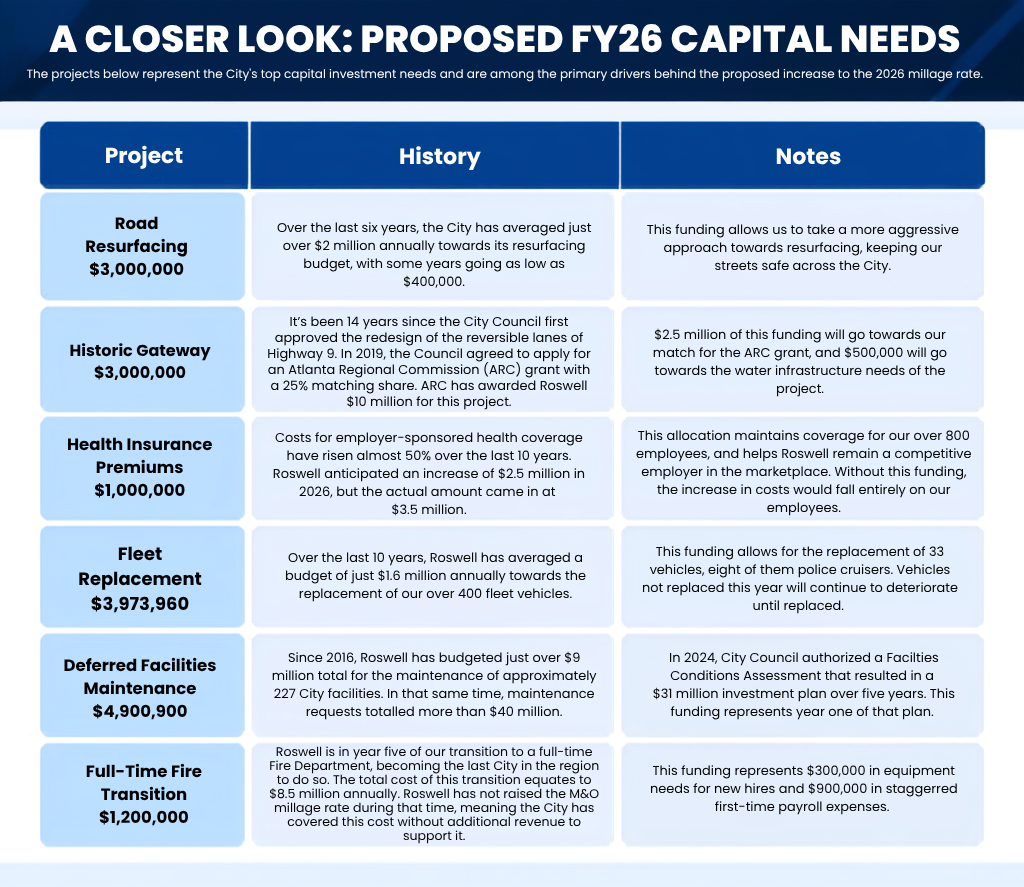
Roswell has identified approximately $18 million in critical capital needs for FY26, ranging from road resurfacing and fleet replacement to rising health insurance costs and the final year of our full-time Fire Department transition.
The spreadsheets below share more information about the needs that are behind Mayor Robichaux’s proposal to increase the City’s millage rate. We encourage residents to review the lists for a full breakdown of what is driving the proposed increase. Please note that this is a proposed, tentative rate only. The final millage rate will not be set until City Council votes on it during a formal public hearing on September 28, 2026. See the list of upcoming meetings further down in this story for opportunities to learn more and share your feedback.
Understanding the Millage Rate
There are two parts to the millage rate: Maintenance & Operations (M&O) and Debt Service.
The M&O portion, proposed at 6.549 mills, funds the City’s day-to-day services, including public safety (police, fire, and E-911), recreation and parks, transportation, and general government services such as administration, finance, and community and economic development.
The Debt Service portion, proposed at 1.183 mills, goes toward repaying the bond program approved by Roswell voters in November 2022, which has funded major capital projects such as the construction of the City’s new parking deck, Public Safety Headquarters, E-911 Center, and many parks and connectivity projects.
A legal notice regarding this proposed increase appeared in the Alpharetta-Roswell Herald on Wednesday, Sept. 3, 2026. Under Georgia law, the City is required to establish a benchmark millage rate for purposes of determining the applicable public notice and public hearing requirements. Because the information necessary to calculate the current-year adjusted rate is not yet available from Fulton County, the City must use the prior year’s millage rate as the applicable benchmark for this process. That rate is 4.049 mills for the M&O portion alone or 5.232 mills for the full rate. Measured against this legally required benchmark, the proposed rate represents an increase of 2.5 mills.
What Does This Mean for My Tax Bill?
One “mill” is equal to $1 for every $1,000 of your property’s assessed value. Your assessed property tax is based on your assessed property value, which is determined by the Fulton County Tax Assessors’ Office. (For more information regarding your assessed property value, please call (404) 612-6440 or visit the Fulton County Board of Assessor’s website.)
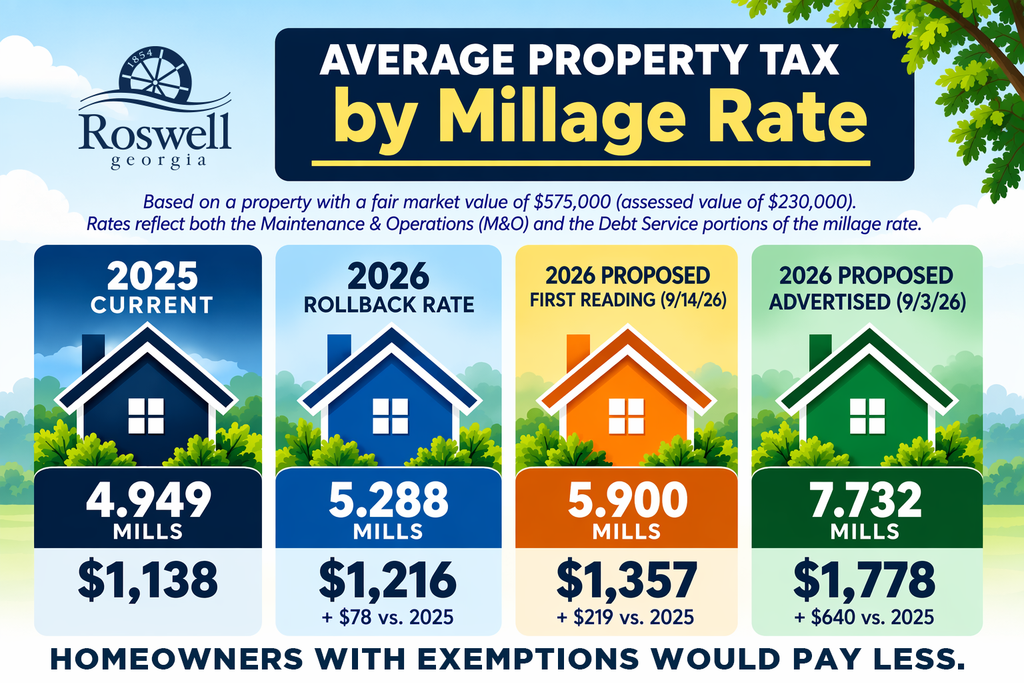
Example: A $575,000 home has an assessed value of $230,000, so each mill costs about $230 before exemptions. For that home, the City portion of the tax bill would be:
- $1,138 at the 2025 rate of 4.949 mills
- $1,216 at the 2026 rollback rate* of 5.288 mills (+$78 vs. 2025)
- $1,357 at the 5.900 mills suggested at First Reading on September 14, 2026 (+$219 vs. 2025)
- $1,778 at the 7.732 mills advertised on September 3, 2026 (+$640 vs. 2025)
Homestead exemptions lower these amounts, and the floating homestead exemption caps annual growth in tax base value at 3%. Mortgage lenders adjust escrow after the bill is issued. Residents can request an individual estimate at taxinformation@roswellgov.com.
*Note: The rollback rate is the rate that would bring in the same revenue as last year. This year it is higher than the current rate because taxable value (as reported by Fulton County) fell, mostly due to increase in floating homestead exemptions.
When Will I Get My Bill and When Is It Due?
Property tax bills are expected to be mailed in mid-October, once the millage rate is formally adopted at the Sept. 28 Second Reading. Payment is due 60 days from the mail date, which typically falls in mid-December. Late fees are assessed starting Jan. 1 on any unpaid balance.
Residents with a homestead exemption, senior exemption, or other applicable exemption will see that reflected in their bill automatically once approved; no additional action is needed if an exemption is already on file. Residents who haven’t yet applied for an exemption can find more information at www.RoswellGov.com/Property-Taxes.
How Can I Learn More and Ask Questions?
Residents are invited to learn more and ask questions at the following public hearings, to be held at the City of Roswell Council Chambers, City Hall, 38 Hill Street, Roswell, Georgia, 30075:
- Monday, Sept. 14, 2026, 7:00 p.m. — First Reading
- Monday, Sept. 21, 2026, 6:00 p.m. — Public Hearing
- Monday, Sept. 28, 2026, 7:00 p.m. — Second Reading and Adoption
Town Hall: In addition, residents can also ask questions directly at a Town Hall dedicated to the proposed millage rate on Wednesday, Sept. 16, from 6:00 to 7:30 p.m. at Eagles Nest Church, 2342 Holcomb Bridge Road.
For more details about Roswell’s millage rate, visit www.RoswellGov.com/Property-Taxes.
Frequently Asked Questions about the Millage Rate
If the 2026 budget is balanced and running ahead, why raise the 2026 rate?
The 2026 budget was adopted assuming a Maintenance & Operations (M&O) rate of 4.049 mills (the 2025 M&O rate), and staff has confirmed that rate covers 2026 operations. Roswell now runs on a calendar fiscal year, so the rate must be set each September, before the next year’s budget is adopted. The proposed increase would fund a capital list that is mostly one-time costs (see next question and answer), not ongoing operations. The exceptions are the final firefighter positions and employee health insurance, which recur, and the fire positions will cost more in 2028 once they are funded for a full year. Revenue from the 2026 rate arrives through December (as residents pay their property tax bills), and many of the projects would be carried out in 2027.
What would the increase pay for, and why now?
Each year, departments submit the capital needs they expect for the coming year. This year’s requests totaled about $31 million, down from about $65 million last year. According to the Mayor, the requests reflect several years of underfunded capital maintenance. Recent assessments also documented the backlog: a Facility Condition Assessment of City buildings, a fleet assessment covering more than 400 vehicles, and the 2023 ADA Transition Plan.
The Mayor reviewed the requests and cut the list to what she considered critical needs, deferring about $13 million in projects. The remaining list, presented item by item at the September 21 Millage Rate Public Hearing, totals about $23.4 million. Staff projects about $5 million in fund balance above the required reserve at year end that could be applied to it. That leaves approximately $18 million to be funded through the millage rate, which the Finance Department estimated at about 2.5 mills.
The largest items:
Building Maintenance ($4.9 million): Repairs were identified in the City’s Facility Condition Assessment, a third-party inspection of more than 200 City facilities. Items already paid for with bond or Public Facilities Authority (PFA) bond funds were removed, and a 10% contingency was added for rising prices. Examples include restrooms at the Public Safety Headquarters, a 38-year-old fire suppression system at the Roswell Recycling Center, and electrical systems at the Water Treatment Plant.
Fleet Replacement ($3.97 million): Replaces 33 vehicles, eight of them police cars, that meet the City’s replacement criteria based on age, mileage, reliability, and repair costs. Vehicles that are not replaced roll onto next year’s list and cost more to maintain in the meantime.
Road Resurfacing ($3 million): The City’s general fund share of resurfacing on the roughly 350 miles of road it maintains. It is supplemented by about $1 million a year in state Local Maintenance and Improvement Grant (LMIG) funds. Roads left too long need full reconstruction, which costs far more than resurfacing.
Historic Gateway ($3 million): The City owes $5.5 million in 2027 under its Gateway agreements: $2.5 million to the Atlanta Regional Commission (ARC), $500,000 to Georgia Department of Transportation (GDOT) for water line improvements, and $2.5 million to move utilities underground. About $2.8 million is already available from TSPLOST I and existing General Fund allocations, leaving $2.7 million. The $3 million request covers that amount plus a $300,000 contingency because utility relocation costs are not final. Stepping away from these commitments could jeopardize future funding from GDOT, ARC, and the National Park Service.
Fire Pumper ($1.4 million): A new frontline fire engine. The engine it replaces moves to the reserve fleet, allowing the City to retire a reserve engine that is past the 25-year service life recommended by the National Fire Protection Association.
Final Year of the Full-Time Fire Transition ($1.2 million): Implements year five of the five-year plan Council adopted in 2022 to move from a part-time to a full-time Fire Department, funding the final firefighter positions and their equipment. Fire call volume has grown more than 40% in a decade, prompting the need for the full-time transition.
Employee Health Insurance ($1 million): The City is self-insured, and claims have grown faster than projected. The full-time fire transition has also added employees to the plan. Without the increase, the City could not cover the expected claims projected by its actuaries.
ADA improvements ($1 million): The 2023 Americans with Disabilities Act (ADA) Transition Plan identified 4,299 accessibility barriers at an estimated $14.1 million. This would start on the highest-impact items. Federal law requires cities to provide equal access to their facilities and services.
Capital Reserve Funds ($1 million each): Two new reserve funds, one for infrastructure and one for public safety, were proposed by the Mayor, so the City can pay for major repairs and equipment without building another backlog. A resolution would set rules for when the money can be used.
Smaller items include signal pole replacements ($400,000), parks maintenance ($378,000), lake dredging assistance ($325,000), a housing study ($250,000), police rifle replacement ($110,000), the 2027 City election (at least $100,000), fire department ballistic gear ($84,000), design of a second entrance to Roswell Area Park from Crabapple ($80,000), building security badge readers ($57,000), an Information Technology (IT) firewall ($55,000), and police laptops ($50,000).
Many of these items are contractual obligations or costs that grow if they are deferred. Taxable value of Roswell’s tax digest (as determined by Fulton County) also fell about $45 million this year, because of the increase in floating homestead exemptions, as well as a 5% reduction in the commercial digest.
What will this mean for my tax bill, including escrow?
Fulton County assesses property at 40% of fair market value, and the City’s rate applies per $1,000 of assessed value. A $575,000 home has an assessed value of $230,000, so each mill costs about $230 before exemptions. For that home, the City portion of the tax bill would be:
- $1,138 at the 2025 rate of 4.949 mills
- $1,216 at the 2026 rollback rate* of 5.288 mills (+$78 vs. 2025)
- $1,357 at the 5.900 mills advanced at first reading on September 14 (+$219 vs. 2025)
- $1,778 at the 7.732 mills advertised on September 3 (+$640 vs. 2025)
These are total rates, combining the M&O rate with the debt service rate (0.900 mills in 2025 and 1.183 mills in 2026). Homestead exemptions lower these amounts, and the floating homestead exemption caps annual growth in tax base value at 3%. Mortgage lenders adjust escrow after the bill is issued. Residents can request an individual estimate at taxinformation@roswellgov.com.
*Note: The rollback rate is the rate that would bring in the same revenue as last year. This year it is higher than the current rate (2025) because taxable value (as reported by Fulton County) fell, mostly due to an increase in floating homestead exemptions.
Why can’t the City use its reserves instead of raising the millage rate?
City policy requires a 25% reserve, currently $25.7 million, which can be used only in emergencies. Council could change that policy by vote. The fund balance also covers cash flow: About a third of revenue arrives in November and December (as residents pay their property tax bills), so the balance drops sharply at midyear. Staff projects about $5 million above the requirement at year end, which is typically used for one-time capital. That amount is already applied to the capital list, which is how the amount needed from the millage rate comes to about $18 million.
The City reports $40.6 million to $49.1 million in fund balance. How much is actually available?
The $49.1 million figure was the balance on December 31, 2025, after 2025 property taxes were collected. The $40.6 million figure is the June 30, 2026, midyear balance shown in the City’s published fund balance graphic. Of that, $25.7 million is the mandated reserve. The remaining $14.9 million above the reserve is committed as follows:
- $6.5 million to fund operations until property tax revenue arrives at the end of 2026
- $2.8 million for road capital approved as part of the 2026 budget
- $2.2 million for vendor payments for services rendered in late 2025 or agreements that span calendar years
- $2.0 million for operating and emergency contingencies
- $1.4 million for merit increases approved by the Mayor and Council in December 2025, effective in April and distributed during the summer
Because the reserve is restricted to emergencies, the cash needed to operate until tax revenue arrives must come from funds above it. Property tax collections in November and December refill the balance, which is why staff projects about $5 million above the reserve at year end.
What costs has the City already cut?
- The COO position was eliminated ($340,000), and a vacated CFO position has not been backfilled ($320,000).
- The City terminated its contract with Seer World, LLC, on May 26, 2026.
- A $104,000 state lobbying contract was canceled.
- A procurement review is underway, and departments are doing task-by-hour analyses.
- Employees will share the health insurance increase.
- About $13 million in capital requests was deferred, including the Green Street Phase Two project, police radios, Cultural Arts Center signage, and a new 911 dispatch system.
An independent audit of three years of procurement and purchasing is also underway, with results expected early next year.
Where did 5.9 mills come from, and what does it include?
A Councilmember proposed 5.9 mills at the September 14 First Reading of the Millage Rate as an alternative to 7.732 mills. Council voted 4-2 to move the item forward. That vote advanced the process but did not set the final rate, which will be determined during the Second Reading on September 28, 2026. No itemized list tied to 5.9 has been published.
Is this a permanent increase, and what is the long-term plan?
The rate is set each year, so a higher rate does not automatically continue. Most items on the list are one-time costs. The Mayor has said she hopes to stabilize or lower the rate over her term. The City is also building a five-year capital plan from its facility and fleet assessments, to be updated annually. The proposed capital reserve funds are meant to prevent a similar backlog in the future. Future rates will still depend on Council’s decision each year.
Why is the debt service rate rising from 0.900 to 1.183?
The 2022 voter-approved bond documents set this schedule as the City drew down the second tranche of bond funding. This debt service millage applies no matter what Council decides on the Maintenance & Operations (M&O) rate.
How much debt does the City carry, and why use PFA loans?
Total obligations, including principal and interest, are about $450 million through 2055. That includes the 2022 bonds, a 2025 Public Facilities Authority bond (PFA) (for the purchase of the Spruill property), and an April 2026 PFA ($13.4 million for City Hall roof and facility repairs). Much of this debt is restricted to specific uses, and some carries prepayment penalties.
A PFA uses a lease-payment structure, the legal framework through which the City repays financing over time. General Obligation bonds, like the program Roswell voters approved in 2022, are well suited to large, long-range capital initiatives and require a voter referendum. The PFA provides an alternative path for addressing targeted needs that arise between those larger programs, with greater scheduling flexibility and typically lower issuance costs.
Why does the City owe $3 million for the Historic Gateway project?
In 2018, City Council applied for an Atlanta Regional Commission (ARC) grant that requires a 25% local match. The City was awarded $10 million from ARC, in addition to Georgia Department of Transportation’s (GDOT’s) larger share. In 2027, the City owes a total of $5.5 million: the $2.5 million ARC match, $500,000 to GDOT for water line improvements, and $2.5 million to move utilities underground. About $2.8 million is already available from TSPLOST I and existing General Fund allocations, so $2.7 million is still needed. The $3 million request covers that gap plus a $300,000 contingency because utility relocation costs are not final. Stepping away from these commitments could jeopardize future funding from GDOT, ARC, and the National Park Service.
Why replace 33 vehicles instead of repairing them?
Vehicles are scored under the City’s APWA-based policy on age, mileage, type of service, reliability, repair costs, and condition. Thirty-three met the replacement threshold, eight of them police vehicles. Many have well over 100,000 heavy-duty miles. Police upfitting costs $20,000 to $30,000 per vehicle and is not recovered at resale. Vehicles that are not replaced roll onto next year’s list and cost more to maintain in the meantime.
Why fund the final year of the full-time fire transition now, and can it be phased?
Council adopted a five-year plan in July 2022, and 2027 is the final year of the transition to a full-time Fire Department. Costs for 2027 are about $1.2 million for the remaining firefighter positions plus equipment for a partial year. It is already phased in 2027, with half the new hires starting in spring and half in summer. Staff has warned that stalling the plan could drive away firefighters already hired.
Why wasn’t the City Hall roof fixed sooner, and what will it cost?
The roof is more than 35 years old and has leaked for years. Formal assessments conducted in 2017, 2021, and 2025 each recommended full replacement. However, past administrations decided to maintain the building through repairs totaling approximately $800,000 over the past 12 years as the underlying condition worsened.
A 2017 estimate for the full replacement was $1.3 million; the current estimate is $6 million to $8 million. The repair is funded by the April 2026 Public Facilities Authority bond (PFA), not by the millage rate. The PFA was approved in March, the loan closed April 16, and procurement is underway. Recently, water damage costs have grown to an estimated $900,000 to $1 million, up from an initial estimate of $700,000, because of additional storms and mold remediation.
Why is the rate set before the 2027 budget, and when can residents see the budget?
When a prior Council moved the City to a calendar fiscal year, state and county deadlines put the millage vote ahead of the budget; last year followed the same sequence. The proposed 2027 budget will be presented October 13 and posted online following the presentation. The budget ordinance includes its own assumed millage rate, set separately from the 2026 rate. No draft 2027 budget exists yet; the document residents may have seen on OpenGov as of September 21, 2026, was an upload test of the system.
Is there tax relief for seniors?
An income-based senior homestead exemption is available, along with disabled and disabled veteran exemptions. Residents can check eligibility at https://www.roswellgov.com/government/departments-division/finance/taxes/property-taxes/ or email taxinformation@roswellgov.com. Staff will look at whether expanding the senior exemption could be part of the 2027 budget.
Why are Roswell’s taxes higher than Alpharetta’s, Johns Creek’s, or Sandy Springs’, and what is being done?
Roswell is more residential than its neighbors. Commercial property makes up only 17% to 18% of the tax base, and much of it was built around 1980. Roswell also maintains a larger parks system than neighboring cities. To make sure new commercial development pays its share of growth-related costs, the City is recalculating commercial impact fees, which are among the lowest in the region. To grow the commercial base, eight to nine major redevelopment projects are underway. Hillrose Market, for example, expects its first tenant in late 2027 or early 2028. The 2045 Comprehensive Plan sets the longer-term strategy.
Why not use water revenue, parks revenue, or bond funds?
The water utility and Recreation Participation Fund, under Recreation and Parks, are enterprise funds. They are funded by their own user fees and cannot be moved to the general fund. Bond proceeds are restricted to the purposes voters approved.